Blog Archives

Coping with nerves

Nerves are a survival trait inherited from our ape ancestors to ensure their survival in the jungle.

Feelings of fear promote the adrenal glands flooding the body with adrenaline. The purpose of adrenaline is to speed up reaction times, it does encourage you to void yourself of waste so that you are lighter and therefore quicker, hence all those trips to the toilet!

Adrenaline therefore is your friend; but mastering the feeling of fear is far harder. Dr Steve Peters in the bestselling The Chimp Paradox suggests many ways to deal with your inner chimp, and is widely endorsed by leading sports people such as Sir Chris Hoy, Victoria Pendleton and Judo’s Karina Bryant.

Here is what Neil Adams MBE has to say about dealing with nerves… Neil himself admits in his autobiography A Life in Judo that failing to master his own psychology probably let him down on occasions when there was no reason when he shouldn’t have won.

http://youtu.be/_0ZoltKLnKQ

Posted in Blog
Tags: , , ,

When you train, you should put more emphasis on learning than on competing with your partner

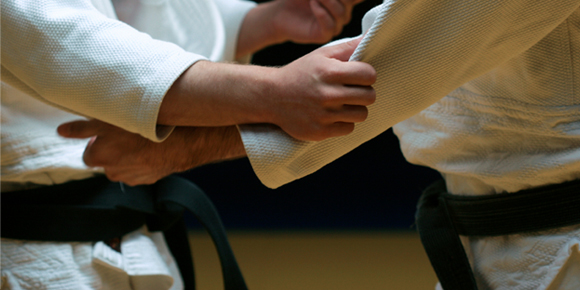
Judo fightWas delighted to see Neil Adams post a link to this article from his Facebook page, I have quoted it in full below:

Rickson Gracie advises on how to train and roll. He emphasizes the fact that Jiu-Jitsu practitioners should focus on the technical side first without using their physical assets. In the words of Rickson himself :

source: Rickson Gracie Association Newsletter

“Even when you spar during training, you should minimize your natural talents. By limiting yourself, you may find yourself in much worse situation, but you are forced to think your way out, using techniques you would not have otherwise used. When you start doing this, you begin to understand what is really wrong in a certain situation and you begin to understand what actually needs to be done in a technical way in order to improve the situation. You then begin to develop a real, deep progress, understanding the mechanics of any situation.

“It is important to remember that in a serious fight or in a competition, the mechanics of the fight will be exactly the same as when you are training in a gentle manner. The only important difference will be your mental attitude. When you train, you should put more emphasis on learning than on competing with your partner.

“You don’t learn when you are fighting, bringing in all sorts of tension and emotion. You learn when you are having fun, training in a smooth and gentle way. You need to work on improving your technique until you are comfortable in any situation. Eventually, you will develop a subconscious understanding of the techniques and they become reflexes. Only after you have done all this you are ready to take your natural abilities “off the shelf” and add them back into your game. Now the effectiveness of the technique will be at least ten times better.”

Which of course is not to say that training cannot be competitive; but you have to learn first and introduce the competitive element after you have gained the technical mastery. Sometimes easier said than done, for all of us!

Gile. (2014, June 19). Rickson Gracie: “When you train, you should put more emphasis on learning than on competing with your partner.”. Retrieved June 20, 2014, from www.bjjee.com: http://www.bjjee.com/articles/rickson-gracie-when-you-train-you-should-put-more-emphasis-on-learning-than-on-competing-with-your-partner/

Posted in Articles, Blog, Training
Tags:

Using a training diary

‘There are three very good reasons for keeping a daily record of your training’, says Neil Adams (Adams & Soames, 1986, p. 34).

‘Firstly, you are constantly learning new techniques and training methods and it is impossible to keep such knowledge at instant recall, whereas writing down everything you learn and experience gives you something to refer back to. It also helps you sort out the good practices from the bad. Secondly, when you have learnt and adopted some kind of structure schedule, the diary provides feed-back in terms of the successful and the unsuccessful elements. Lastly, a training diary can help to prevent the sportsman from becoming ‘coach dependent’, because it helps to provide the necessary information for the player to set out his own short-term goals and to formulate long-term aims and objectives.

‘I used to write down everything in my training diary. I wrote down how I felt during the day, including whether I felt mental pressure one day, and physical pressure the next. I wrote down which throws worked in randori, why and on whom, and why others didn’t. I made a note of exactly what I did, how far I ran, which weights I pushed, what I didn’t do and why. And I tried not to cheat.

‘I also described what I observed, particularly about other judo players who were in my weight or above, and through that I became accustomed to watching and analysing, instead of just getting on the mat and getting up a good old sweat. And after contests, I would fill pages and pages with my reports so that I knew the strengths and weaknesses of every player I was likely to come across. Although I have never been very good at mathematics or thinking logically, I can now retrieve and use information about opponents very quickly. But at the start I had to write my thoughts down. So, for instance, about Chris Bowles I wrote: ‘Main throw, ouchi-gari (not very strong tai-otoshi). Seoi-nage under pressure. Gripping good. Doesn’t like left-handers. Left-hand grip with right foot forward.’ Then I would would note the last time I fought him: ‘Three minutes fighting for grips, attacked him with seoi-nage. Nothing. Tai-otoshi, scored koka. Ouchi-gari, scored koka. Let him attack with ouchi-gari, countered, scored waza-ari.’ Or I would put in reasons why he made it difficult for me, what I did, why I changed my tactics half way through. I made the same kind of entry for all my opponents.’

Works Cited
Adams, N., & Soames, N. (1986). A Life in Judo. London: Willow Books.

Posted in Articles, Blog, Training
Tags: ,

Categories

Archives