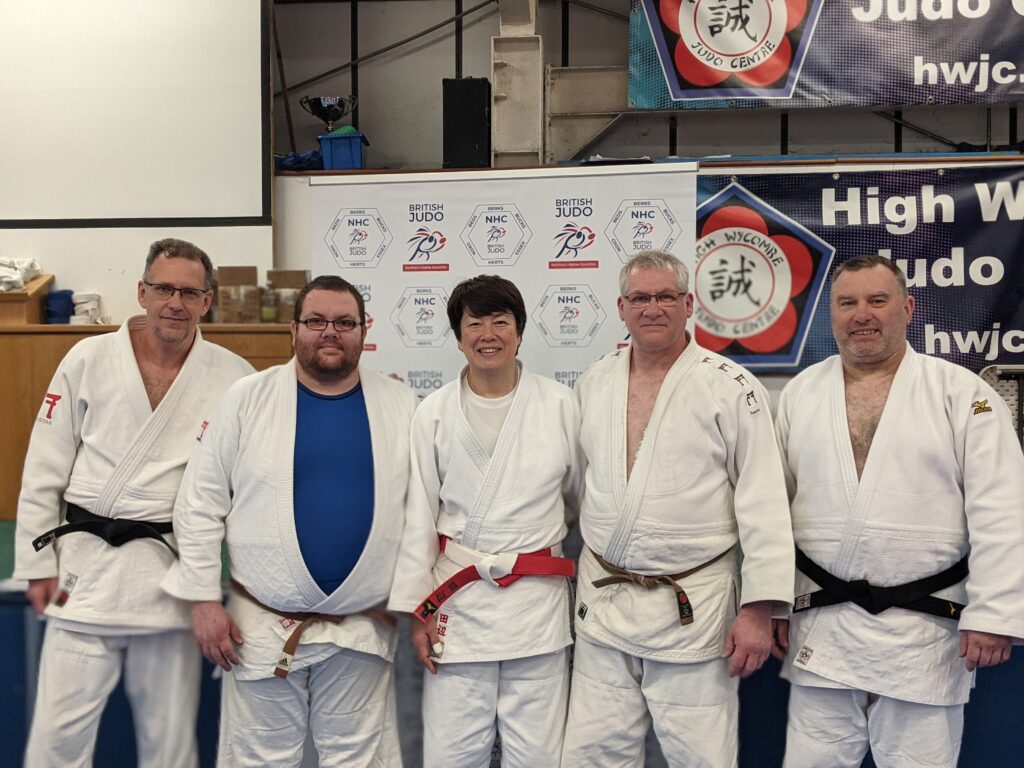
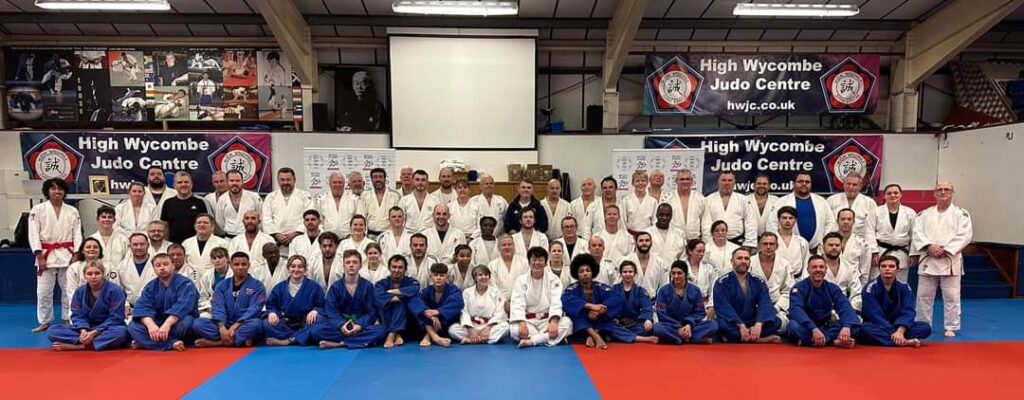
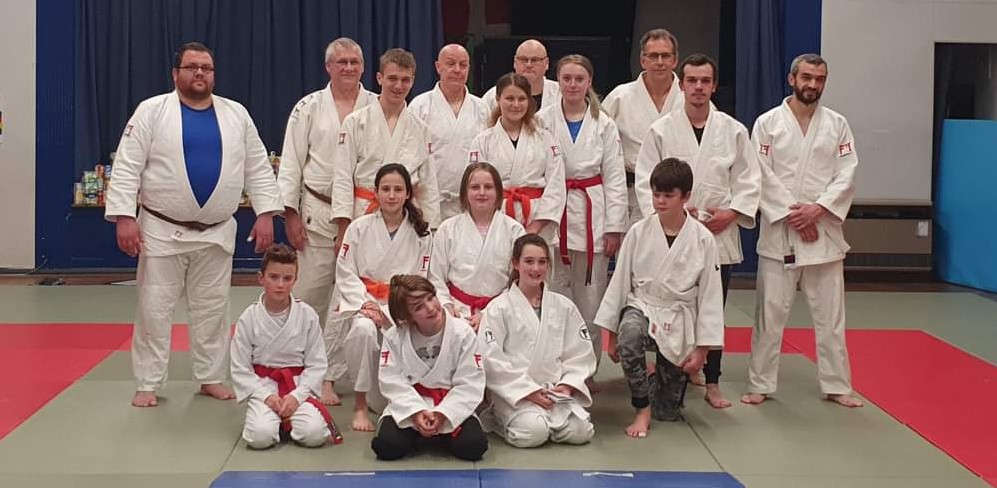
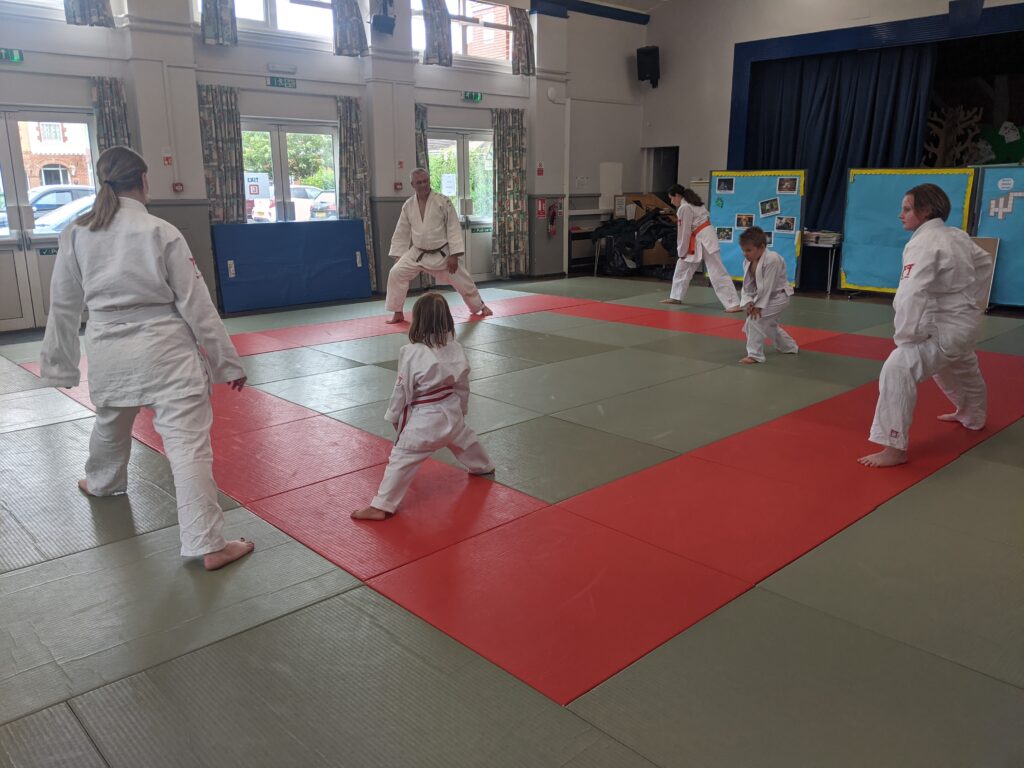
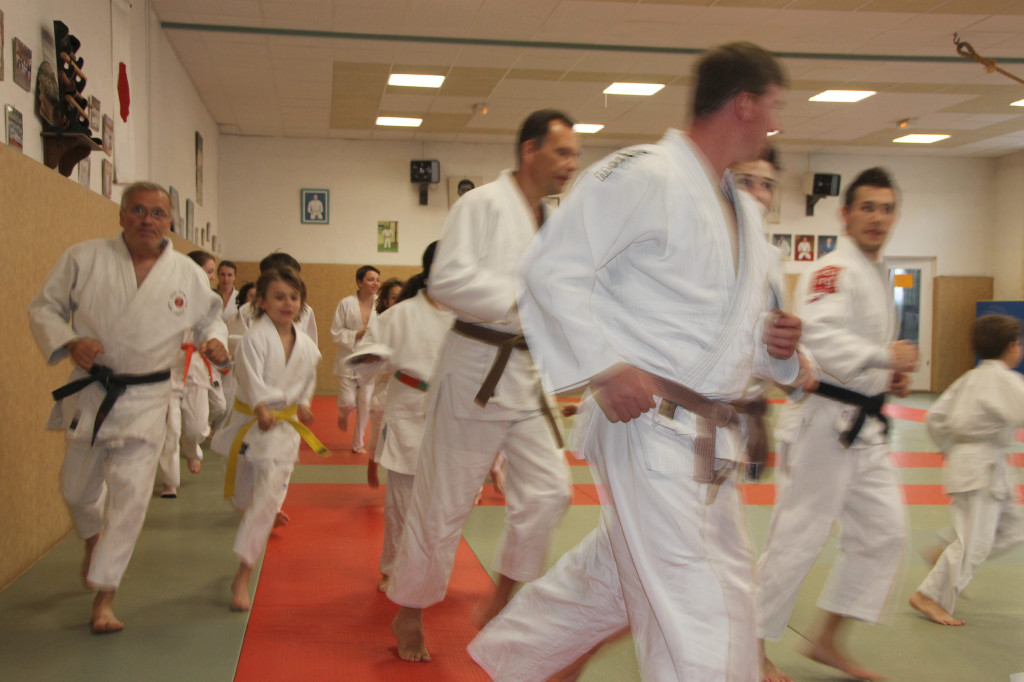
Tony, Craig, Kev and Steve travelled to High Wycombe Judo Centre on 12 February for a training session with multiple Olympic and World medallist and six time All-Japan champion Yoko Tanabe.
The day was split into two sessions – ne waza and tachi waza (i.e. ground and standing techniques).
Yoko presented a range of simple, basic but effective techniques that will improve the quality of your judo – techniques which we ruefully wish we had learnt years ago but will be incorporating into our own coaching and practice going forward.
The day was very well supported, with a wide range of grades in attendance.
The Judo competition will run from 1-3 August. There will be extensive coverage via the BBC and iPlayer, as exclusive host broadcaster. The first session – knock out and repechage in the men and women lightweights – starts at 10am on Monday 1st, with the medal fights being held later in the day.
The home nations of England, Scotland and Wales will do well, possibly a medal for Northern Ireland. Australia and Canada are also sending some big names. You can never rule out a surprise result from India or one of the African countries either!
Did you know that Court Lane Judo Club has links to the Commonwealth Games?
Brett Caswell was training partner for Team England’s Sophie Cox in the run up to the 2002 Manchester Games.
The 1×1 metre mats that we use every session came from the same edition of the Games – they were used in the warm up area.
Outside of the Commonwealth Games, there is also a Judo Commonwealth tournament, which now features Junior and Veteran divisions. Court Lane’s Brett Caswell won the inaugural Junior Commonwealth tournament in 2006.
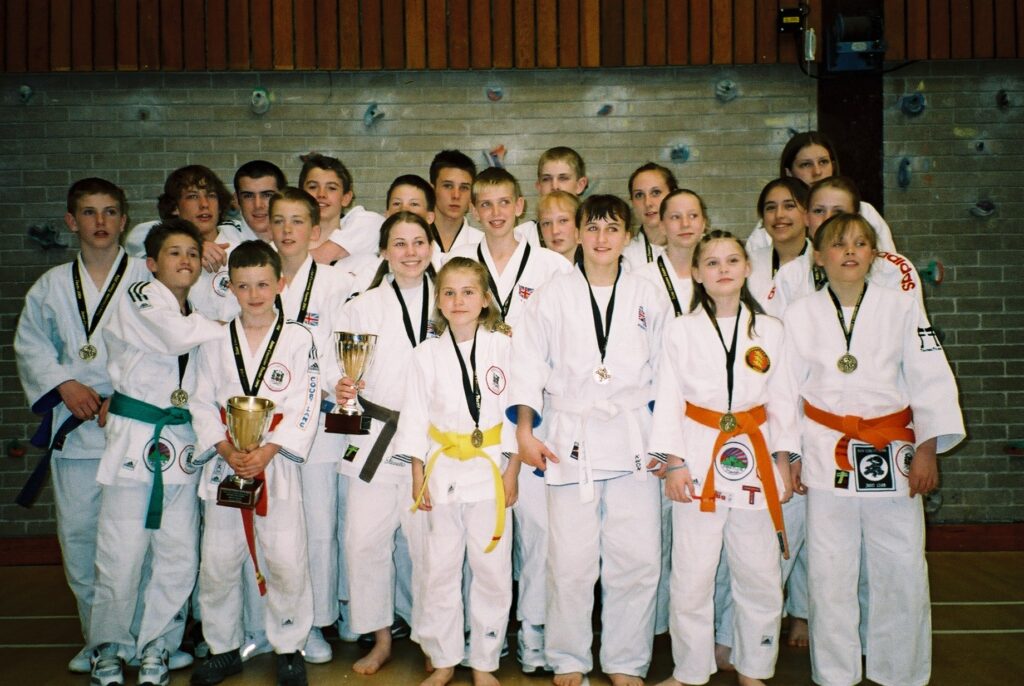
After a hiatus caused by the Covid pandemic, the Southern Area intercounties tournament will resume this year. Hampshire has a proud record in this event: the winning boys and girls teams from 2004 are pictured. (Court Lane’s Lewis Dolman is holding the trophy, with Andy Gould wearing GB patch behind him).
This year’s edition will be held in Eastleigh on Sunday 8th May. Hampshire’s team will be announced based on squad attendance and results at Hampshire Closed, to be held in April.
The event has been restructured, and will now feature more but smaller teams than previous years, along with grade banded mixed gender adult teams.
Each team will consist of 7 players with there being six categories – u12 years of age boys and girls teams, u16 years of age boys and girls teams, senior mixed kyu grade teams and senior mixed dan grade teams. Technical restrictions will be in place for the u12 teams and armlocks and strangles permitted only in the senior events, minimum age 14 years.
Team Formats
U12 Boys u27kg, u30kg, u34kg, u38kg, u42kg, u46kg and o46kg
U12 Girls u28kg, u32kg, u36kg, u40kg, u44kg, u48kg and o48kg
U16 Boys u42kg, u46kg, u50kg, u55kg, u60kg, u66kg and o66kg
U16 Girls u40kg, u44kg, u48kg, u52kg, u57kg, u63kg and o63kg
Mixed Senior Kyu Grade (maximum grade 2nd Kyu) Men u66kg, u81kg, u100kg and o100kg Women u57kg, u70kg and 070kg
Mixed Senior Dan Grade (minimum grade 1st Kyu) Men u66kg, u81kg, u100kg and o100kg Women u57kg, u70kg and 070kg
Senior teams will fight alternately M, F, M, F, M, F, M
Regardless of the changes, team judo is one of the most exciting competition formats and this promises to be an exciting day as always!
Three sessions in to the New Year, and we are delighted to to see everyone back on the mat!
The tatami is as busy as it was at the end of last year – indeed even busier, with new faces joining in on every session! In fact we are so busy that we are seriously considering purchasing more mats to expand our mat area.
We are also looking at expanding our payment options, using a card reader to enable card payment rather than cash, and re-establishing a dedicated adult session. This would enable us to better separate adults and younger players, and let us move some junior members up to the next session.
More news on these developments will follow.
We are blown away by your support and enthusiasm, and look forward to 2022 being a great year!
As we near the end of a year, we’d like to say Thank You to everyone who has supported the Club this year.
When we reopened following the lifting of restriction on indoor contact sports, we really had no idea who would re-appear. So to see the Club growing this year, with a well attended first time summer season and adults joining us from the September onwards, has been amazing.
The increase in numbers, as well as fantastic support from Window Workshop and grant support from British Judo, has put the Club in the strongest position it has been in for years. Certainly not what we were expecting as we re-opened under the spectre of Covid.
It was great to have Maddi rejoin us on the front desk. Even better to get her back on the mat just before Christmas.
Thank you too to those who have signed up to support us via our two fundraising streams, Easyfundraising and the Portsmouth Lottery – details can be found here.
Whilst like everyone else we are keeping an anxious eye on announcements from Government due to the rise of the Omicron variant, we look forward to seeing everyone back on the tatami in 2022. We will advise if there are any changes to the planned dates.
It is fantastic to see so many returning and new faces on the mat – last night was our biggest session for some time. We are very happy to welcome you to the Club.
It is easy to forget as life returns to normal that the coronavirus is still in circulation – 45,066 cases were logged on Thursday, over 7,000 people are in hospital with Covid and sadly the death toll is running at between 800 – 1,000 per week. Obviously the vaccine has significantly reduced the risk of infection and hospitalisation, but it is not 100% effective.
The virus is largely airborne, as we enter the autumn/winter season it will become more transmissible and with us all spending more time indoors, the risk of infection will rise.
We will endeavour to keep doors / windows open for as long as practical in the hall to ensure a steady supply of fresh air.
Please continue to follow best practice on hand hygiene – hand sanitiser is available in the hall.
Whilst Government requirements and restrictions have been lifted, and parents are welcome to stay and watch, mask wearing and distancing is still recommended.
The club has a Test and Trace QR code – this is displayed on the board when you enter the hall, you can check in using the Covid-19 app.
If you should return a positive test result or are showing symptoms associated with Covid, please do not attend training sessions. This advice applies to all illnesses – it is general good practice, both for yourself and to protect other people in such a close contact sport as judo.
Although the last 12 – 15 months have been hard, it has been great to keep in touch with so many of you – either via social media or bumping into you in the street etc.
We thought it would be nice to briefly update on what some of the club’s former faces are now up to…
John Luijken has relocated with his family to Holland, and is still continuing his judo studies there.
Azhar Baree is studying economics at Southampton Uni – where he bumped into former Court Lane alumni Lewis Dolman on the mat. Lewis has now moved to Birmingham…
Jonty Bassil is joining the Navy, with an aspiration to become a PTI. Best of luck Jonty!
Isla Savellis-Fry has competed her studies at South Downs College, and is offering sports massage at Bodyworx 360 in Leigh Park as well as a mobile service. You can contact her via her her Facebook page – Isla’s Massage Therapy – or her mobile 07389 821386
Messages from Government today indicate that it is likely that lifting of final restrictions covering gatherings, sports participation etc. are likely to be delayed following a rise in positive tests, largely linked to the new Delta variant. Reassuringly hospital cases, whilst growing, are not increasing at the same rate, indicating that the vaccine programme is effective (with caveats about number of received doses).
It looks as if adult judo judo will be delayed until mid July – and as we are likely to be shut over the school holidays, that effectively means September for us.
We will confirm more detail as soon as we can.
In the meantime, the mantra (vaccinated or not) remains Hands – Face – Space – Fresh Air.
Under the Government’s plan to exit coronavirus restrictions, it was envisaged that all restrictions in England would be lifted on 21st June, meaning that adults could return to full contact training from that date. (Currently adults could train indoors, with no contact other than people from their family group. At the moment, we have chosen to work just with under 18s who are allowed full contact).
Each stage of the lifting of restrictions is dependent on:
the vaccine deployment programme continues successfully
evidence shows vaccines are sufficiently effective in reducing hospitalisations and deaths in those vaccinated
infection rates do not risk a surge in hospitalisations which would put unsustainable pressure on the NHS
UK Government assessment of the risks is not fundamentally changed by new Variants of Concern
You will be aware of course that a new variant has emerged, which appears to be even more transmissible than the variant that drove huge hospital admissions over the winter months. The latest evidence is that the Pfizer and AstraZeneca vaccinations continue to offer good protection against the latest variant, but that there is a rise in infection showing amongst the younger age groups who may not have received the vaccination as yet. This will be driven in part by the relaxing of restrictions, as well as the new variant.
So, will adults be able to return to training towards the end of June?
For a definitive answer, we will need to wait for an announcement, probably in week commencing 14th June; but we are cautiously optimistic.
We envisage however that registering attendance via the Club’s QR code and submitting a Covid declaration will remain a requirement for the foreseeable future. It is possible that regional restrictions or increased testing may be applied to manage local outbreaks – we understand extra testing capacity has been created in north Hampshire recently, linked to the latest variant. (Portsmouth City Council yesterday sounded the alarm about an increase in local cases, although it is still a long way short of the figures seen earlier in the year).
In the meantime, please continue to practise Hands – Face – Space
A particular joy over the last couple of years has been rediscovering sumo. First broadcast to British audiences by Channel 4 in the 1980s, with commentary by Syd Hoare (a Judo 6th dan) major tournaments are now broadcast by NHK World, or can be viewed on YouTube.
Major tournaments are held in odd months (January, March, May…)
It is perhaps an acquired taste – but once you get across the initial shock you get to realise that sumo has much in common with judo – action, reaction, breaking of balance, momentum – and shares many of the same techniques – seoinage, leg and foot sweeps… Although player health and safety at tournaments does need to be looked. The lack of a safety area outside the raised contest area is a concern that should be addressed.
Current idols of the sport include the Mongolian yokozuna Hakuho (who is likely to play some part in the Olympic opening ceremony) and up and coming stars such such as Enho, Wakatakakage, and Tobizaru.
One of the greatest stars of the sport was the late yokozuna Chiyonofuji, thankfully no one now approaches the size of the giant Hawaiian, Konishiki!